Week 8
Wednesday, Oct. 15th: 1. Finish Blog 7. 2. Read this piece from the Carnegie Endowment for Peace. Click on one of the links in “The Way Forward” section and prepare something to say about what you find there. 3. Be thinking about ideas for a final project. That will be blog post 8.
Friday, Oct. 17th: 1. Continue discussion of reading from Wednesday 2. Read this medium post on Arendt 3. Read the first section (I’ve removed the rest anyway) of “Lying in Politics” from Arendt, and here is a fuller 8th blog post prompt. Finally, more from Arendt, starting with Section 7 from The Human Condition, The Public Realm: The Common
For those interested. Here’s the interview I mentioned with Eliezer Yudkowsky (the doomer).
Week 9
Monday, Oct. 20th:
We can start with thinking about the way in which data centers are expanding. I had Gemini create this report on data center expansion. It gives an overview of the issue. As with any AI report like this, you’ll want to check sources before taking it very seriously.
Here is Marx’s classical treatment of how economic crises arise (and will repeatedly arise in capitalist economies): Read part I of the Manifesto, which you’ll find on p. 228 of the pdf linked here/p. 219 of the original pagination. This is just a pamphlet, but it outlines the kind of analysis one might make from this perspective.
For Wednesday, Oct. 22nd:
- Make sure you’ve posted blog 8. 2. We’ll continue the economics/policy discussion from last time. 3. New reading: Basic Income Parijs and Vanderborght, Ch. 5 Ethically Justifiable? Free Riding v. Fair Shares 4. Watch for additional sources on AI and economics.
For Friday. 1. continue economics discussion. finish Ch 5 from above. 2. Read about automation at Amazon 3. Chapter 6 from Basic Income (on the economics). I’ve now linked the whole book if you’re interested in other arguments and facets of the proposal. Finally, 4. Here’s a very recent study by a researcher at Stanford detailing what we know and don’t know about job loss and creation because of AI.
Week 10
For Monday, Oct. 27th: Let’s continue the economics discussion. We haven’t discussed the feasibility question, See ch. 6 from the book on basic income from last week. We also haven’t dealt with their response to the freeloader problem from Ch. 5. So here’s the assignment. After reading both the second half of Ch. 5 and most of Ch. 6, write a blog post, call it blog post nine, in which you create some fiction in a world with both extensive replacement of humans with AIs and automation and in which some version of a universal basic income is in place.
We’ve talked about some of the implications of AI for employment. But, haven’t examined in any detail other economic aspects. For those of you interested in whether the whole AI/data center expansion/GPU production is a bubble here’s a sort of explainer that summarizes some figures from both sides of this debate.
Wed. Oct. 29th: We can begin two discussions that feed out of the discussions of economics and politics. 1. The international affairs implications of AI and 2. the question of existential threats to humanity. Examine the AI-2027 document if you haven’t already.
Tonight: a special guest lecture by Dr. Alan Coverstone, titled:
Reclaiming Human Intelligence in the Age of AI: Plural Futures for Education and SocietyWednesday, October 29, 2025 7:00 p.m.
Ballroom C, Rucker University Center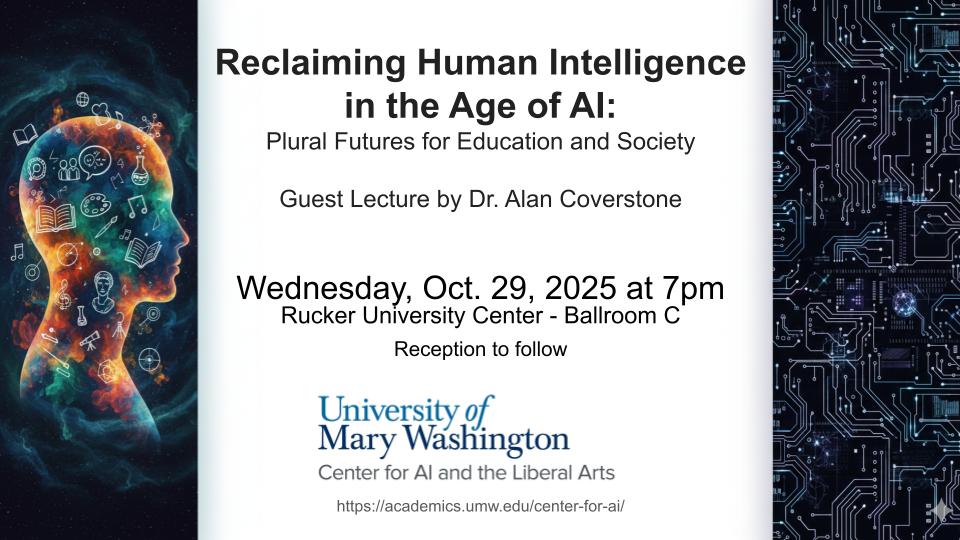
As mentioned in class you can write up an “extra” blog on this talk if you attend. It’s obviously not required.
For Friday, then, we’ll continue the discussion of future AI. Here’s a long interview with Nick Bostrom on AI superintelligence as an existential threat and other discussions.
And, here’s a primer on the AI race between China and the US.
As promised here are links to three dystopian stories that might help you think about your blog nine project:
The Ones who walk away from Omelas by Ursula Le Guin
There will come soft rains by Ray Bradbury
I have no mouth and I must scream by Harlan Ellison
Living without AI for 48 hours. Piece from the New York Times.
Week 11
Monday, Nov. 3rd: 1. Finish Blog Post 9. 2. Read someone else’s story. 3. And come with one question about either one of the three stories above, your colleagues’ stories, or the Bostrom interview from last week, again see above. [For example, here’s one thing I wanted to get your reaction on: Bostrom repeatedly talks about how maybe it’s time we stop treating even LLMs as things and start thinking of them more like children. That is, maybe we should stop manipulating them and be transparent with them, at least within limits. What might this look like?] 4. Read or listen to the Living without AI for 48 hours piece.
FYI: final project. Here’s a sketch of some possible ideas:
Notes on the Final Project. Due Nov. 21
Recall that the final project is 10% of your final grade.
There are lots of possible forms the project could take. I talked through a few last week:
Essays on e.g. AI Consciousness; Responsibility and AI; AI, Automation, and UBI.
Other sorts of creative projects:
Co-write a story with AI and write a reflective essay on the experience
Red team an AI. Try to break an AI’s ethical safeguards and write report on the results.
Use AI as a research assistant and fact check and analyze the end result for bias.
There are 4 grading criteria areas:
1. Concept and philosophical relevance (are you engaging with an interesting, important, valuable philosophical concept, e.g. consciousness, justice, ethical reasoning, etc.
2. Integration of form and content: is the medium appropriate to the content?
3. Execution and craft.
4. Creativity and originality.
Wednesday, Nov. 5th: Begin Blog Post 10. For Blog post 10, update your blog post 8 on what you’re thinking of regarding your final project. Try especially to think through the listed questions about the medium of your project. In addition to the Living without AI for 48 hours piece, read this piece on work and meaning.
Friday, Nov. 7th: See this bibliography on meaningful work. Obviously we can’t read all of this. But, if your project is on this topic, this is super useful.
A classic qualitative study on work in America from the early 1970s. These are statements from real people about the work they do: Studs Turkel, Working. You can also check out from the late 90s: this excerpt from Nickel and Dimed by Barbara Ehrenreich . And here’s Barbara Ehrenreich’s reflection on Nickel and Dimed from 2011.
Week 12
For Monday, Nov. 10th: First priority is thinking about Blog post 10, even if you’re unsure about some of the answers. That is, you want to think about the medium as you’re thinking about content. I’ve had some great conversations with people about their projects; if you want to talk about ideas come to my office hours or send me an email.
Second Priority of Nov. 10th. We still haven’t talked about Living without AI for 48 hours. Nor did we return to the question of MEANING with regard to different sorts of work. So, think about anything you want to articulate on the topic of meaning and work.
New pieces on old topics:
A different way to think about whether AI is conscious.
New study on AI Agents. Gives evidence for the idea that AI doesn’t replace us, but helps us (at least at an individual level).
Environment and AI. Here’s the debate I did with Dr. Kaitlyn Haynal from Comm and Digital Studies.
Kate Crawford’s book, Atlas of AI is a key reading for understanding AI’s global impact. Here’s an excerpt. Ch. 1 on The Earth is pp. 23-31 in the original pagination.
Stuff I mentioned:
Chinese robot walks realistically.
For Friday, Nov. 14th:
If you don’t recall, Here’s what we’re talking about when we talk about “philosophical zombies.”
Barbara Gail Montero, AI is on its way to something even more remarkable than intelligence
Fred Dretske, “How do you know you are not a zombie?”
Week 13
Monday, Nov. 17th: We’ll continue the discussion of consciousness in Barbara Gail Montero, AI is on its way to something even more remarkable than intelligence.
Here’s the piece that connects to the discussion of emotion we had: Alison Jaggar, “Love and Knowledge: Emotion in Feminist Epistemology”
Wednesday, Nov. 19th: Do read the First part of the Jaggar piece posted for Monday. That is read up through the top of p. 161 in the original pagination.
Friday, Nov. 21: Sign up for portfolio presentations during WK 15 (Dec. 1, 3, 5). Here’s some information on the final portfolio, the presentation, and the reflective essay.
Week 14
Monday: Nov. 24th: Come again with questions, possibilities, etc. for your portfolio. We’ll just get into groups/compare notes to see what’s working.
Week 15
Reminder. Turn in your final project URL here: https://canvas.umw.edu/courses/1549941/assignments/13224643
Presentations on your Portfolio
If your name isn’t in the list below, email me with a preferred date.
Dec. 1: Presentations from Carly, Aiden, Spencer, Will, Marquis, Sean, and Amani, and Connor
Dec. 3: Presentations from Callie, Fainas, Maddie, Clarissa, Sophia, Kole, Noah
Dec. 5: Presentations from Chloe, Michael, Amber, Aidan, Ryan, Mackenzie, Madelynne O., Katie
Your final portfolio will be due Tuesday of finals week. Dec. 9th. I will post a link here to a canvas assignment where you can put the url for your table of contents (which should then link out to the rest of the elements in your portfolio). Again, here’s the portfolio assignment.
Finals Week
Put your portfolio Table of Contents URL here in canvas.
AND, finally. After you’ve done everything else, please fill out this final self-evaluation.